Virginia Emissions Readiness Monitors "Not Ready"? Why Cars Get Rejected, and the New 2026 Waiver
Virginia emissions readiness monitors show "not ready" when your car hasn't finished its own self-tests. On 2001 and newer cars, two or more not-ready monitors get the car rejected from testing: not a failure, and no fee. A new battery, cleared codes or too little driving usually causes it. About a week of normal driving usually fixes it.
What "not ready" means on a Virginia emissions test
Most 1996 and newer cars get an OBD test instead of a tailpipe test, according to DEQ. The inspector plugs into the port under your dash and reads the car's computer, including its readiness monitors. Those are self-tests the car runs on systems like the catalytic converter, the oxygen sensors and the fuel vapor (EVAP) system. Each one reports "ready" once it has finished.
Virginia's emissions regulation, 9VAC5-91-420 (subdivision C 8 b), says an OBD car is rejected from testing when:
| Model year | Rejected when |
|---|---|
| 1996 through 2000 | Three or more monitors are not ready |
| 2001 and newer | Two or more monitors are not ready |
| Any OBD car back for a reinspection after failing for a catalytic converter code | The catalyst monitor is not ready |
So a 2001 or newer car can test with one monitor not ready, unless it's the catalyst monitor on a car that already failed for a converter code.
Rejection is not failure. Section G 3 of that same regulation says a check engine light commanded on for an emissions code makes the car fail. A not-ready status gets it rejected. DEQ's page says you won't be charged for a rejection and that "a rejection is not the same as a failed emissions test." If your light is on, that's a different problem. Our post on the check engine light and Virginia inspection covers it.
Why cars that sit, or get a new battery, come up not ready
The EPA's guidance for state test programs (EPA420-R-01-015, June 2001) lists the common reasons a car shows up not ready:
- The battery was disconnected or replaced. That resets the car's computer, and every monitor starts over.
- Codes were cleared, or maintenance was done, right before the test.
- The car hasn't been driven under the conditions a monitor needs. Each monitor waits for its own mix of driving before it runs.
That last one hits Old Town hard. A car parked on the street all week while you take Metro from King St or Braddock Rd, then driven a few blocks on Saturday, may never get the drive its monitors need. Winter adds the battery problem: a battery that dies in the cold gets replaced, and the monitors start over. Our post on cars that sit all week covers the rest of the wear.
The EVAP monitor is often the last one to finish. An EPA memo from May 4, 2011 calls it the hardest monitor to set, because it often needs the car to run within a certain temperature range, and the weather doesn't always cooperate.
How to get the monitors ready
- Don't disconnect the battery or clear codes before a test. It doesn't hide a problem. It just resets the monitors and gets the car rejected.
- Drive the car normally for about a week. EPA's 2001 guidance says a week of normal driving is enough to set the monitors on most cars. Fewer than 1% need a trip to a repair shop to get them set.
- Mix it up. A cold start after the car sits overnight, some town driving, some steady-speed stretches. The exact drive cycle depends on your make, model and which monitor is lagging, as New York's DMV explains, so check your owner's manual.
- Check monitor status before you go back. A scan tool shows which monitors are ready, so you don't waste a trip. If we find your car not ready, there's no charge, and we'll tell you which monitors still need to finish before we can run the test. If a monitor still won't set after a week or two of real driving, something may be keeping it from running. That's a diagnostics job, not a driving job.
- If the battery is the reason it reset, make sure the new one, the cables and the charging system are healthy. A battery and charging test rules that out.
Timing: retests, rejections and your registration
If your car needs emissions, DMV won't register or renew it until it passes or gets a waiver, per DMV. Here is how the clock works, from DEQ:
| What happened | What it costs | What's next |
|---|---|---|
| Rejected (not ready) | No inspection fee | Drive, then come back for a full test |
| Failed (for example, an emissions code with the check engine light on) | Normal test fee | One free retest at the same station within 14 calendar days |
For a two-year registration, test no earlier than 90 days before the registration expires. Test earlier and you may only get a one-year renewal.
Running out of time? DMV offers a one-month registration extension to get the emissions test done. You ask for it in person at a DMV customer service center or DMV Select, while the registration is still valid, in the month it expires. It costs a $10 administrative fee plus prorated registration, and you get one per registration period.
The 2026 law: a waiver when the car is still not ready at reinspection
Virginia passed SB 767 and the identical HB 312 in 2026. The Governor approved them on April 22, 2026 as Chapters 1027 and 1045, effective July 1, 2026. Most of each bill is about auto glass repair shops. The emissions part is one added clause in § 46.2-1181.
Before: a car could qualify for a repair-cost waiver only if it failed an initial inspection and then failed the reinspection.
Now: it can also qualify if it failed an initial inspection and its OBD system is in a not-ready condition when it comes back for reinspection. That's the classic trap: the car fails for a code, the repair clears the codes, the monitors reset, and the car can't be tested again.
The rest of the waiver rules still apply. Under DEQ's waiver regulation, 9VAC5-91-420 M, as amended in the Virginia Register, Vol. 43, Issue 4, October 5, 2026 (the amendment takes effect November 4, 2026), you need all of these:
- A failed initial inspection first. A car that was only rejected for not ready on its first visit hasn't failed, so this path doesn't start there.
- Emissions repairs made, and at least the waiver amount spent on them. DEQ's page puts the amount at $1,090 on or after January 5, 2026. It's adjusted for inflation, and the amount that applies to you is printed on your failure report. (DEQ's "How do I get an inspection?" page still shows an older $850 figure from 2019.)
- Repairs done at a DEQ Certified Emissions Repair Facility, by or under a Certified Emissions Repair Technician. DEQ says money paid to anyone else doesn't count toward a waiver.
- Proof: an itemized bill or paid work order, plus the Emissions Repair Data Form filled out by the certified facility.
- Repair work done no earlier than 60 days before the initial inspection.
- No visible smoke, and a pass on the visual check of the emissions control parts. Missing, disconnected or tampered parts have to be put back.
One caution: when we checked DEQ's waiver page in October 2026, it still said a waiver isn't granted for a rejection from testing and still described the older retest rule. The statute (in effect since July 1, 2026) and the amended regulation (which takes effect November 4, 2026) cover this one case. If you think you qualify, call DEQ at 703-583-3900 (the number DMV lists) before you count on it.
Under the same regulation (subsection B), the station has to tell you before the test whether it can do the emissions repairs for your car if it fails. We're a DEQ Certified Emissions Repair Facility, so if your car fails, qualifying emissions repairs done here can count toward a waiver.
Quick answers
Can you pass Virginia emissions with one monitor not ready? On a 2001 or newer car, one not-ready monitor doesn't stop the test, unless it's the catalyst monitor on a car back for a reinspection after a converter code. On 1996 to 2000 models, up to two can be not ready.
How long do monitors take to reset? EPA's guidance says about a week of normal driving for most cars.
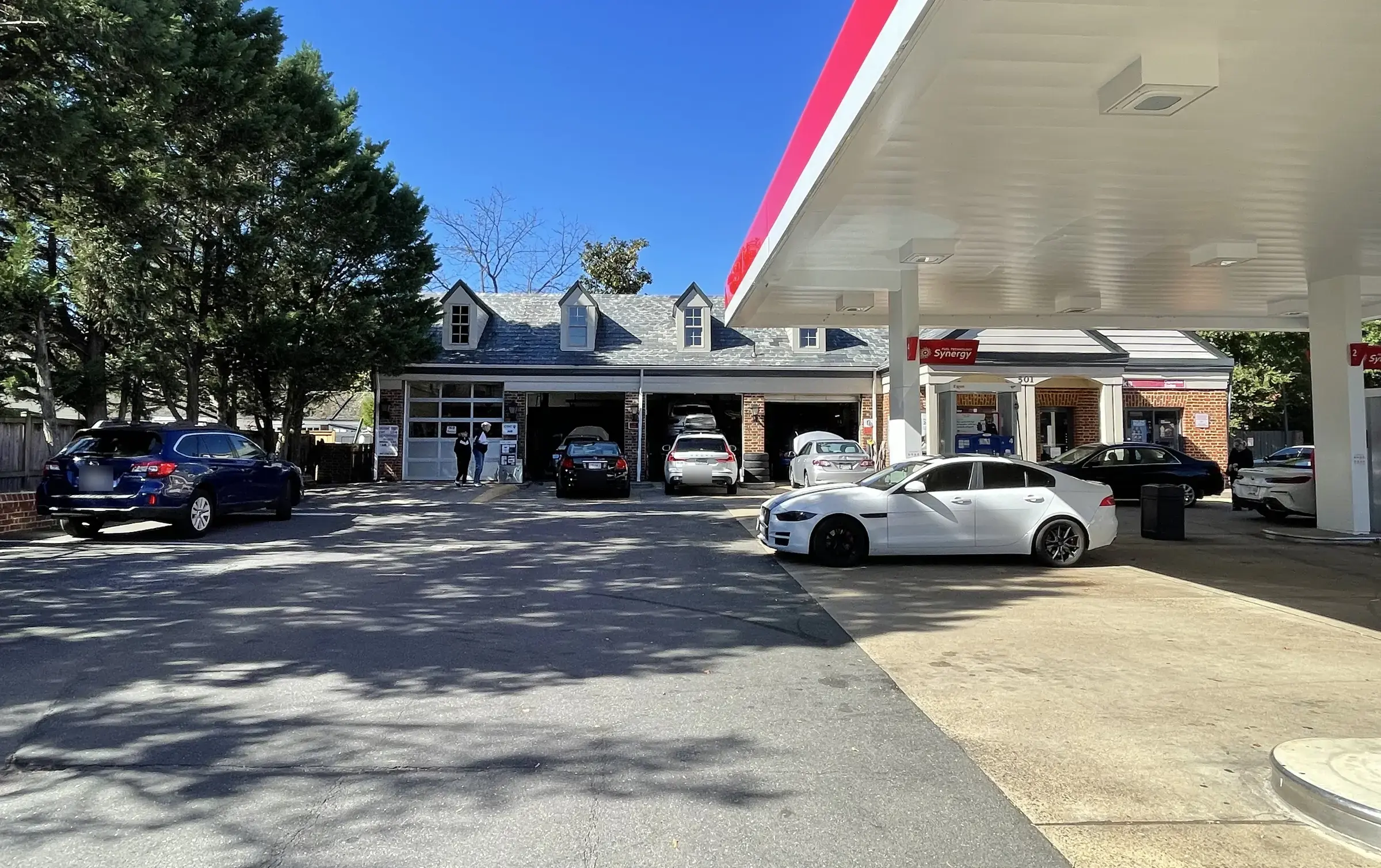
We're a DEQ Air Check emissions station at 501 S. Washington St at Wilkes St, at the south end of Old Town, near Route 1 and the Wilson Bridge. Call (703) 549-6631 with questions. The inspection lane runs along the brick wall on the left side of the lot, starting at the "Inspection Lane Starts Here" sign. See our emissions inspection page for the fee and how to book.
Sources
- 9VAC5-91-420, Inspection procedure; rejection, pass, fail, waiver (Virginia Administrative Code)
- Virginia Register of Regulations, Vol. 43, Issue 4 (October 5, 2026): amendment to 9VAC5-91-420, effective November 4, 2026
- SB 767 (2026), Chapter 1027, chaptered text, and HB 312 (2026), Chapter 1045 (Virginia LIS)
- Va. Code § 46.2-1181, Emissions inspection; cost of repairs; waivers
- DEQ Air Check: How do I get an inspection?
- DEQ Air Check: Why did my vehicle fail?
- Virginia DMV: Emissions Inspections
- U.S. EPA, Performing Onboard Diagnostic System Checks as Part of a Vehicle Inspection and Maintenance Program (EPA420-R-01-015, June 2001)
- U.S. EPA, Improving I/M Performance and OBD Monitor Readiness (memo, May 4, 2011)
- New York DMV: What do you mean my car's not ready?
Ibrahim, Service Department
Ibrahim has spent nearly 10 years in the automotive industry. At Old Town Exxon, Ibrahim works across the service department, from the bays to the back office.
Related Services
Need a Hand With Your Car?
Call or book online. We're at S. Washington & Wilkes St, 501 S Washington St, Alexandria, VA 22314.